In this digital project created by Leslie C., she focuses on suffrage activism in Nebraska and how it spreads. She starts off by explaining the background of women suffrage in the west, specifically Nebraska, and mentions how the West was a place where women’s civil rights were expanded by the local and state government. The purpose of this project is to show the importance of women’s history to a broad audience while also showing individuals how to create a site with tools that are easy to manage and learn. Leslie she breaks the information up into 4 main sections: The…
-
-
Part 1 Although many people overlook the smaller Asian countries, like the Philippines, that were a part of the effects of comfort women from Japanese soldiers during World War II, it’s important for the stories of these Women to be shared so we can really understand how the Japanese affected women all over Asia. In this paper the focus will be on stories from comfort women from the Philippines and how the Japanese affected their lives. Part 2 Primary McCarthy, Julie. “Philippine Survivor Recounts Her Struggle As A ‘Comfort Woman’ For Wartime Japan.” Asia. NPR, November 29, 2020. https://www.npr.org/2020/11/29/939811000/philippine-survivor-recounts-her-struggle-as-a-comfort-woman-for-wartime-japan. Rodell,…
-
In this article, it shows that technology is a great way for history and museums to be accessible to everyone. Technology helps provide different learning styles, multiple languages, and appeal to a more diverse audience. It also allows innovative ways for museums to tell their stories. Museums have started to use augmented reality (AR), virtual reality (VR), and extended reality (XR) to give a more personable and hands-on experience. The use of technology is used in many ways across museums across the world. For example, high resolution 3D scans of fossils are used to provide access either online or in…
-
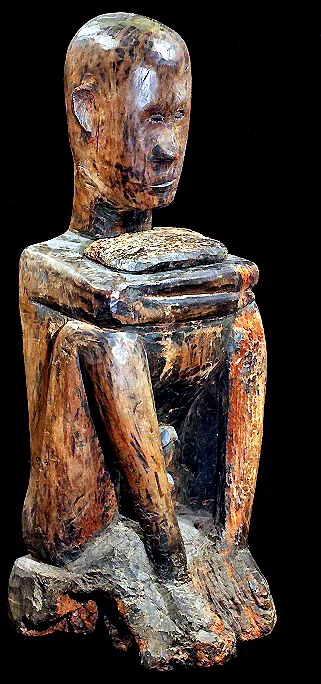
For my artifact I chose the Bulul. The Bulul is a statue that originates from the Philippines, specifically the Ifugao province. It’s traditionally carved from the wood from Narra trees in Ifugao and are carved into many different styles including a man with hands on knees, standing straight with arms on the side, or squatting down with arms on top of knees, like the one in the photo. The Bulul was used to guard rice crops from rodents and pests; it was also believed to help grow crops and produce more rice. They are important to the Ifugao history as…